Indus Valley Civilization MCQ practice is the most critical step for aspirants targeting UPSC, SSC CGL, and Railways. In this comprehensive guide, we cover the 50 most expected questions to help you score high. This top-rated mock test ensures you master the ancient history concepts quickly and effectively.
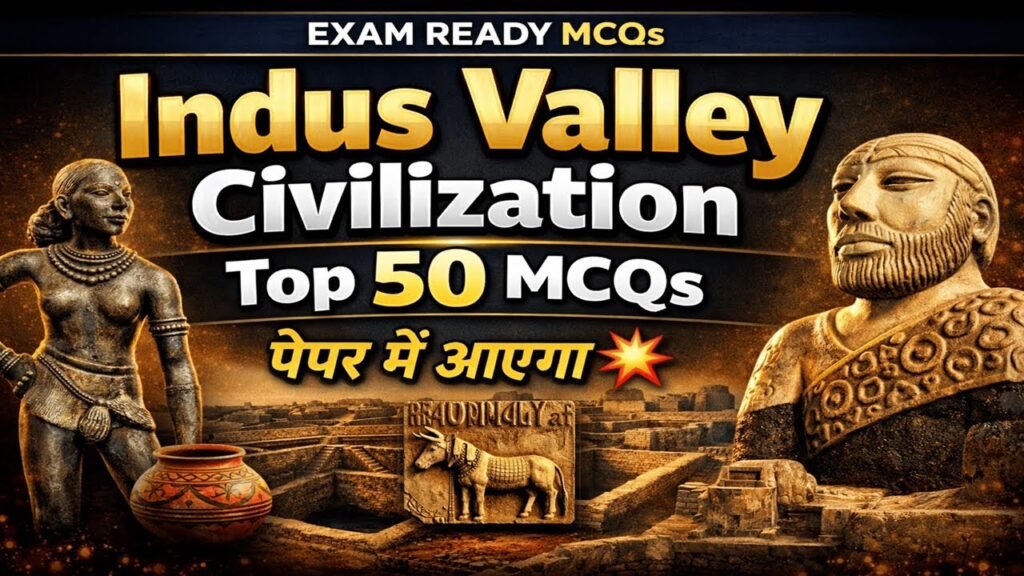
Practice Indus Valley Civilization MCQ (Live Mock Test)
⚠️ Content Protected
Join our Telegram for PDF: t.me/ExamReadyMCQs
Indus Valley Civilization MCQ – Top 50 MCQs Solved (50 MCQs Test)
⚠️ Select an answer!
According to Radiocarbon Dating (C-14), which of the following is the most accepted timeframe for the Mature Harappan Phase of the Indus Valley Civilization?
Explanation:
Correct: B
While the civilization had Early and Late phases, the “Mature” urban phase is scientifically dated to approximately 2500 BC – 1750 BC based on C-14 analysis. Mastering this timeline is essential for solving any chronological Indus Valley Civilization MCQ in your exam.
▶ Watch Video Explanation
Who among the following archaeologists was the first to discover the ruins of Harappa in 1921?
Explanation:
Correct: C
Rai Bahadur Dayaram Sahni excavated Harappa (on the banks of river Ravi) in 1921, marking the discovery of the civilization. R.D. Banerji discovered Mohenjodaro the following year (1922). This implies Harappa was the first site excavated, giving the culture its name.
▶ Watch Video Explanation
Consider the following pairs of Harappan sites and the rivers they are situated on:
1. Harappa — Indus
2. Mohenjodaro — Ravi
3. Lothal — Bhogava
4. Kalibangan — Ghaggar
Which of the pairs given above are correctly matched?
1. Harappa — Indus
2. Mohenjodaro — Ravi
3. Lothal — Bhogava
4. Kalibangan — Ghaggar
Which of the pairs given above are correctly matched?
Explanation:
Correct: B
Pairs 1 and 2 are swapped. Harappa is located on the banks of the Ravi, while Mohenjodaro is located on the banks of the Indus. Lothal (Bhogava) and Kalibangan (Ghaggar) are correctly matched. Geographic location is a frequent topic in Indus Valley Civilization MCQ sections.
▶ Watch Video Explanation
Which of the following statements regarding the geographical extent of the Indus Valley Civilization is/are correct?
1. The northernmost site is Manda (Jammu & Kashmir).
2. The southernmost site is Daimabad (Maharashtra).
3. The easternmost site is Alamgirpur (Uttar Pradesh).
1. The northernmost site is Manda (Jammu & Kashmir).
2. The southernmost site is Daimabad (Maharashtra).
3. The easternmost site is Alamgirpur (Uttar Pradesh).
Explanation:
Correct: D
The civilization formed a huge triangle-like area. Manda (Chenab) is in the North, Daimabad (Pravara) in the South, Alamgirpur (Hindon) in the East, and Sutkagen Dor (Dasht) is the westernmost site in Baluchistan. This extent makes it larger than contemporary Egypt and Mesopotamia.
▶ Watch Video Explanation
Which of the following major Indus Valley Civilization sites is NOT located within the present-day territory of India?
Explanation:
Correct: C
Chanhudaro is located in the Sindh province of Pakistan. Dholavira and Lothal are in Gujarat (India), and Rakhigarhi is in Haryana (India). Aspirants must distinguish between Indian and Pakistani sites for the SSC CGL History section.
▶ Watch Video Explanation
Identify the incorrect statement regarding the materials and metals known to the Indus Valley people:
Explanation:
Correct: C
The Indus Valley Civilization was a Bronze Age civilization. The people were not aware of Iron. The use of Iron in the Indian subcontinent began much later, during the Vedic period (around 1000 BC). This distinction is a classic trap in Indus Valley Civilization MCQ tests.
▶ Watch Video Explanation
Consider the following statements regarding urbanization:
Assertion (A): The Indus Valley Civilization is classified as an urban civilization.
Reason (R): The civilization was characterized by systematic town planning, drainage systems, and the use of burnt bricks.
Assertion (A): The Indus Valley Civilization is classified as an urban civilization.
Reason (R): The civilization was characterized by systematic town planning, drainage systems, and the use of burnt bricks.
Explanation:
Correct: A
The classification of IVC as “Urban” is primarily defined by its sophisticated infrastructure, including the grid system of roads, covered drains, and standardized burnt bricks. This distinguishes it from rural chalcolithic cultures of the same era.
▶ Watch Video Explanation
Scenario: An archaeologist discovers a site in the Rann of Kutch, Gujarat. The site is unique because it is divided into three parts (Citadel, Middle Town, Lower Town). It also features a highly advanced water harnessing system. Which site is being described?
Explanation:
Correct: B
Dholavira is distinct for its tripartite division (most sites have two parts) and its elaborate system of reservoirs and dams for water management. The “Dholavira Signboard” is also a famous discovery there, making it a key topic for Ancient History UPSC questions.
▶ Watch Video Explanation
The local name of which among the following Indus Valley Civilization sites means “Mound of the Dead”?
Explanation:
Correct: B
Mohenjodaro (in Sindhi language) literally translates to “Mound of the Dead.” It was the largest urban centre of the civilization and housed the Great Bath. This etymology is often asked in Railway and SSC exams.
▶ Watch Video Explanation
The Indus Valley people were the first to produce which of the following crops, which the Greeks called ‘Sindon’?
Explanation:
Correct: C
The Indus people were the earliest known producers of Cotton. The Greeks called it ‘Sindon’ (derived from ‘Sindhu’ or Indus). While Wheat and Barley were staple food crops, Cotton is the unique contribution of this civilization to the textile world.
▶ Watch Video Explanation
Match the following Harappan sites with their unique archaeological findings:
1. Lothal — Dockyard
2. Kalibangan — Ploughed Field
3. Banawali — Terracotta replica of a Plough
4. Surkotada — Horse Remains
Which of the pairs given above are correctly matched?
1. Lothal — Dockyard
2. Kalibangan — Ploughed Field
3. Banawali — Terracotta replica of a Plough
4. Surkotada — Horse Remains
Which of the pairs given above are correctly matched?
Explanation:
Correct: D
All pairs are correctly matched. Lothal has an Artificial Dockyard; Kalibangan has evidence of the earliest Ploughed Field; Banawali has a Toy plough; and Surkotada provided evidence of Horse bones. Memorizing these matches helps solve complex Indus Valley Civilization MCQ sets.
▶ Watch Video Explanation
The famous ‘Pashupati Mahadeva’ seal found at Mohenjodaro depicts a yogi surrounded by animals. Which of the following animals is NOT depicted on this seal?
Explanation:
Correct: D
The Pashupati seal depicts an Elephant, a Tiger, a Rhinoceros, and a Buffalo around the yogi, with two Deer at his feet. The Cow and the Lion are notably absent from the seal. This detail is crucial for Art and Culture questions.
▶ Watch Video Explanation
Identify the correct statement regarding the Town Planning of the Indus Valley Civilization:
Explanation:
Correct: B
The “Grid System” is a hallmark of IVC. Uniquely, house entrances opened into side lanes, not the main streets (to avoid dust and noise). The drainage system was covered and highly advanced, showing excellent civic sense.
▶ Watch Video Explanation
Which of the following statements regarding the Indus Script is/are incorrect?
1. It is a pictographic script.
2. It was written in Boustrophedon style (Right to Left, then Left to Right).
3. It has been fully deciphered by modern historians.
1. It is a pictographic script.
2. It was written in Boustrophedon style (Right to Left, then Left to Right).
3. It has been fully deciphered by modern historians.
Explanation:
Correct: C
Statement 3 is Incorrect. The Indus script remains undeciphered to this day. Statements 1 and 2 are correct; the script used symbols/pictures and was often written in Boustrophedon style. This mystery is a common theme in Harappan Civilization questions.
▶ Watch Video Explanation
Consider the following statements:
Assertion (A): The Indus Valley Civilization is distinct from the contemporary civilizations of Mesopotamia and Egypt regarding construction materials.
Reason (R): The Indus people used standardized burnt bricks on a massive scale.
Assertion (A): The Indus Valley Civilization is distinct from the contemporary civilizations of Mesopotamia and Egypt regarding construction materials.
Reason (R): The Indus people used standardized burnt bricks on a massive scale.
Explanation:
Correct: A
The extensive use of burnt bricks of a standardized ratio (4:2:1) is a unique feature of the Harappan culture, distinguishing it from the sun-dried brick construction common in Mesopotamia. This standardization reflects a centralized authority.
▶ Watch Video Explanation
Scenario: You are excavating a major Industrial centre of the Harappan civilization. You find factories for bead-making, shell-cutting, and seal-making. Surprisingly, this is the only major city that does not have a fortified Citadel. Which site are you at?
Explanation:
Correct: B
Chanhu-daro (in Pakistan) is famous as an industrial centre (Bead factory) and is the only major Harappan city without a Citadel (fortified upper town). This exception is a favorite topic for tough Indus Valley Civilization MCQ papers.
▶ Watch Video Explanation
The “Great Bath,” a massive tank used for ritual bathing, was found at which of the following Indus Valley sites?
Explanation:
Correct: B
The Great Bath is the most important public place of Mohenjodaro. It is surrounded by corridors and is made watertight with burnt bricks and gypsum mortar. It suggests the culture placed high importance on ritual purity.
▶ Watch Video Explanation
The famous statue of the “Dancing Girl,” a masterpiece of Harappan art, is made of which material?
Explanation:
Correct: C
The “Dancing Girl” found at Mohenjodaro is made of Bronze. It is one of the earliest examples of the “Lost Wax” casting technique, showcasing the advanced metallurgical skills of the Indus people.
▶ Watch Video Explanation
In the ancient Mesopotamian texts (Sumerian), the Indus Valley Civilization was referred to by which name?
Explanation:
Correct: C
Mesopotamian texts refer to trade relations with Meluha, which is identified as the Indus Valley region. Dilmun (Bahrain) and Magan (Oman) were intermediate trading stations. This proves international trade links existed during the Bronze Age.
▶ Watch Video Explanation
Which of the following statements about the Weights and Measures of the Indus Valley Civilization is/are correct?
1. They used a standardized binary system of weights (1, 2, 4, 8, 16…).
2. The ratio/base unit for weights was 16.
3. They used foot-scales made of shell and ivory.
1. They used a standardized binary system of weights (1, 2, 4, 8, 16…).
2. The ratio/base unit for weights was 16.
3. They used foot-scales made of shell and ivory.
Explanation:
Correct: D
The weights proceeded in a binary series (1, 2, 4, 8, 16, 32, etc.) in the lower denominations. The unit of 16 was the standard base. Linear scales of shell (Mohenjodaro) and ivory (Lothal) confirm their obsession with accuracy.
▶ Watch Video Explanation
Regarding the religious practices of the Indus Valley Civilization, which of the following features has NOT been found?
Explanation:
Correct: C
While the Harappans worshiped the Mother Goddess, Pashupati, trees, and animals, no temple structures or distinct places of worship have been found. This distinguishes them from the Egyptians and Mesopotamians who built massive religious structures.
▶ Watch Video Explanation
Which Harappan site has yielded evidence of a burial practice where a dog was buried along with a human in an oval pit?
Explanation:
Correct: A
Ropar (Punjab) is famous for the discovery of a grave where a dog was buried below a human oval pit burial. This unique burial practice highlights the domestication of animals. Note that Lothal is known for “Double Burial”.
▶ Watch Video Explanation
Consider the following statements about Harappan craftsmanship:
Assertion (A): The Harappan civilization had a highly developed aesthetic sense.
Reason (R): They employed the ‘Cire Perdue’ or ‘Lost Wax’ technique for casting metal statues.
Assertion (A): The Harappan civilization had a highly developed aesthetic sense.
Reason (R): They employed the ‘Cire Perdue’ or ‘Lost Wax’ technique for casting metal statues.
Explanation:
Correct: A
The “Lost Wax” technique (Cire Perdue) involves making a wax model, covering it with clay, melting the wax out, and pouring molten metal into the hollow mold. The “Dancing Girl” is a prime example of this advanced craftsmanship.
▶ Watch Video Explanation
Scenario: You are examining a seal from the Indus Valley. It is square in shape, made of a soft stone, and features an animal carving with a script above it. What is the most likely material of this seal?
Explanation:
Correct: B
The vast majority of Indus Valley seals (over 2000 found) were made of Steatite (a soft soapstone). They were used for commercial purposes (authenticating trade goods) rather than as currency, a key fact for any Indus Valley Civilization MCQ.
▶ Watch Video Explanation
Which among the following structures is the largest building found at Mohenjodaro?
Explanation:
Correct: B
While the Great Bath is the most famous, the Great Granary is the largest building discovered at Mohenjodaro. Similar granaries (storehouses for grain) were also found at Harappa, indicating a surplus economy.
▶ Watch Video Explanation
Archaeological evidence of “Fire Altars” (suggesting ritualistic fire worship) has been found at which of the following sites?
Explanation:
Correct: B
Kalibangan (Rajasthan) and Lothal (Gujarat) have yielded distinct fire altars. This suggests that fire rituals were a part of the religious life in these specific regions, differing from the Great Bath rituals of Mohenjodaro.
▶ Watch Video Explanation
Regarding the burial practices of the Harappan people, which of the following statements is NOT typical?
Explanation:
Correct: B
The most common practice was extended inhumation (burying the dead body). While some post-cremation urn burials exist, complete cremation was not the dominant standard. Option C (Double Burial at Lothal) is a specific famous exception.
▶ Watch Video Explanation
Who among the following historians/archaeologists propounded the theory that the “Aryan Invasion” was the cause of the decline of the Indus Valley Civilization?
Explanation:
Correct: B
Mortimer Wheeler famously accused the Vedic god Indra of destroying the Harappan cities (“Indra stands accused”), citing the presence of skeletons in Mohenjodaro streets. However, modern research largely disputes this invasion theory.
▶ Watch Video Explanation
The stone sculpture of the “Bearded Priest” or “Priest King,” wearing a trefoil-patterned shawl, was found at:
Explanation:
Correct: B
The “Priest King” is a steatite sculpture found at Mohenjodaro. The trefoil pattern on his shawl suggests a connection to Mesopotamian motifs, highlighting the artistic depth of the era.
▶ Watch Video Explanation
Which of the following animals was most frequently depicted on the seals of the Indus Valley Civilization?
Explanation:
Correct: C
The most common animal depicted on the seals is the Unicorn (a mythical one-horned creature), followed by the Humped Bull. The Cow, Lion, and Horse are generally absent from the seals, a vital fact for solving Indus Valley Civilization MCQ tests.
▶ Watch Video Explanation
Match the following sites with their primary excavators/archaeologists:
1. Harappa — Dayaram Sahni
2. Mohenjodaro — R.D. Banerji
3. Lothal — S.R. Rao
4. Dholavira — J.P. Joshi / R.S. Bisht
Select the correct option:
1. Harappa — Dayaram Sahni
2. Mohenjodaro — R.D. Banerji
3. Lothal — S.R. Rao
4. Dholavira — J.P. Joshi / R.S. Bisht
Select the correct option:
Explanation:
Correct: D
All pairs are correct. Harappa was found by D. Sahni (1921), Mohenjodaro by R.D. Banerji (1922), Lothal by S.R. Rao (1954), and Dholavira by J.P. Joshi (1967). Knowing these names is essential for state PSC exams.
▶ Watch Video Explanation
Scenario: Excavations at this site yielded a unique terracotta model of a ship, indicating its maritime importance. It also had a dedicated bead-making factory and is located near the Gulf of Khambhat. Which site is this?
Explanation:
Correct: B
Lothal is the premier maritime site. The terracotta ship model and the bead factory (also found in Chanhudaro) confirm its identity as a trade port. It was the gateway for overseas trade with West Asia.
▶ Watch Video Explanation
Match the following raw materials imported by the Indus people with their source regions:
1. Copper — Khetri Mines (Rajasthan)
2. Lapis Lazuli — Shortughai (Afghanistan)
3. Gold — Kolar (Karnataka)
4. Tin — Afghanistan/Iran
Select the correct option:
1. Copper — Khetri Mines (Rajasthan)
2. Lapis Lazuli — Shortughai (Afghanistan)
3. Gold — Kolar (Karnataka)
4. Tin — Afghanistan/Iran
Select the correct option:
Explanation:
Correct: D
The Harappans had a vast trade network. Copper came from the Khetri mines (Rajasthan). Gold from South India (Kolar). Lapis Lazuli and Tin were imported from Afghanistan and Iran. This network proves their economic complexity.
▶ Watch Video Explanation
While Wheat and Barley were the main crops, evidence of Rice cultivation (Rice Husks) has been found at which of the following pairs of sites?
Explanation:
Correct: B
Evidence of Rice is rare in IVC compared to wheat/barley. However, rice husks embedded in clay and pottery have been distinctly found at Lothal and Rangpur (both in Gujarat). This suggests regional agricultural variations.
▶ Watch Video Explanation
Consider the following statements regarding society:
Assertion (A): The nature of the Indus Valley society is believed to be Matriarchal.
Reason (R): Terracotta figurines of the Mother Goddess have been found in large numbers across many sites.
Assertion (A): The nature of the Indus Valley society is believed to be Matriarchal.
Reason (R): Terracotta figurines of the Mother Goddess have been found in large numbers across many sites.
Explanation:
Correct: A
Unlike the later Vedic society which was Patriarchal, the abundance of Mother Goddess figurines suggests that women held a high status and the society was likely Matriarchal in nature. This is a common sociological question in UPSC.
▶ Watch Video Explanation
The origin of which common Indian religious symbol can be traced back to the Indus Valley Civilization?
Explanation:
Correct: B
The Swastika symbol appears on many Indus seals and is believed to have originated there, likely associated with sun worship or good luck. It was later adopted into Hinduism, Buddhism, and Jainism.
▶ Watch Video Explanation
Which of the following observations regarding the decline of Mohenjodaro is/are correct?
1. The city shows evidence of being destroyed and rebuilt at least seven times.
2. The primary cause for these destructions is attributed to massive flooding of the Indus river.
1. The city shows evidence of being destroyed and rebuilt at least seven times.
2. The primary cause for these destructions is attributed to massive flooding of the Indus river.
Explanation:
Correct: C
Excavations at Mohenjodaro reveal multiple layers of silt and reconstruction (up to 7 levels), strongly supporting the theory that recurring floods were a major cause of its decline. This environmental factor is often tested in Indus Valley Civilization MCQ tests.
▶ Watch Video Explanation
A hoard of bronze goods, including a famous “Bronze Chariot” driven by a man with two bullocks, was found at which site (often considered the southernmost outpost)?
Explanation:
Correct: A
Daimabad (Maharashtra) is the southernmost Indus site. It is famous for the “Daimabad Hoard,” which includes solid bronze figures of a chariot, an elephant, a rhinoceros, and a buffalo, showcasing the reach of the culture.
▶ Watch Video Explanation
“Faience,” a material commonly found in Indus sites used to make beads and small vessels, is best described as:
Explanation:
Correct: B
Faience was not a natural stone; it was an artificial material. Sand or powdered quartz was fused with a binding agent and then glazed, usually resulting in a blue or sea-green color. It was considered a luxury item.
▶ Watch Video Explanation
Scenario: An archaeologist finds a site in Haryana. The site is significant because it yielded high-quality barley grains and a terracotta replica of a plough, but strangely, the town planning lacked the strict “Grid System”. Which site is this?
Explanation:
Correct: A
Banawali (Hisar, Haryana) is known for two things: the discovery of high-quality barley and the terracotta plough. Interestingly, its drainage system and road layout were less strictly organized compared to the perfect grids of Mohenjodaro.
▶ Watch Video Explanation
The characteristic pottery of the Indus Valley Civilization is best described as:
Explanation:
Correct: D
Harappan pottery is primarily Red Ware (wheel-made) with designs (geometric patterns, animals) painted in Black. (Note: PGW is associated with the later Vedic period, and NBPW with the Mauryan era).
▶ Watch Video Explanation
Which among the following is currently recognized as the largest Indus Valley Civilization site located within the territory of India?
Explanation:
Correct: B
Rakhigarhi (Hisar, Haryana) is the largest Harappan site in India. Recent excavations suggest it might even be larger than Mohenjodaro (Pakistan), which was traditionally considered the largest overall site of the civilization.
▶ Watch Video Explanation
Regarding the Political Organization of the Indus Valley Civilization, which statement is most widely accepted by historians?
Explanation:
Correct: C
Unlike Egypt or Mesopotamia, no palaces or royal tombs have been found. The uniformity in weights, bricks, and planning suggests a central authority, but it was likely a committee of merchants (Oligarchy) rather than a single king.
▶ Watch Video Explanation
The name of the site “Kalibangan” (Rajasthan) literally translates to:
Explanation:
Correct: B
“Kali” (Black) + “Bangan” (Bangles). The site yielded huge quantities of black terracotta bangles, giving it its name. It is also famous for the ploughed field and fire altars, frequently appearing in Indus Valley Civilization MCQ tests.
▶ Watch Video Explanation
While the Indus people relied on flood irrigation, evidence of a developed Canal Irrigation system has been found at only one distant trading outpost. Which site is this?
Explanation:
Correct: B
Shortughai (located in Afghanistan) is a unique Harappan trading post near the Lapis Lazuli mines. It is the only site where distinct traces of canals for irrigation have been discovered, unlike the flood-based irrigation in the Indus plains.
▶ Watch Video Explanation
Consider the following statements:
Assertion (A): The Indus Valley seals were primarily used as coins or currency for trade.
Reason (R): The seals were made of valuable metals like Gold and Silver.
Assertion (A): The Indus Valley seals were primarily used as coins or currency for trade.
Reason (R): The seals were made of valuable metals like Gold and Silver.
Explanation:
Correct: D
Both statements are False. Seals were used for commercial identity (tagging goods/ownership), not as currency (barter system prevailed). Furthermore, seals were primarily made of Steatite (stone), not gold or silver.
▶ Watch Video Explanation
Which of the following statements characterizes the religious outlook of the Indus Civilization?
1. It was a secular civilization where the religious element was present but not dominant.
2. The society was intolerant of other practices.
1. It was a secular civilization where the religious element was present but not dominant.
2. The society was intolerant of other practices.
Explanation:
Correct: A
The civilization is considered secular in the sense that while religion existed (Pashupati, Mother Goddess), there was no domineering theocratic state machinery (like huge temples or priest-kings) imposing it on the population.
▶ Watch Video Explanation
Scenario: Excavations at this specific site provided evidence of a massive Earthquake (the earliest recorded in history) which likely forced the people to abandon the settlement around 2600 BC. Which site is this?
Explanation:
Correct: B
Kalibangan provides evidence of the earliest recorded earthquake. The Early Harappan settlement there was destroyed by a quake, after which the Mature Harappan phase was built on top of it. This is a unique geographical fact.
▶ Watch Video Explanation
Among the following animals, which one has not been found depicted on the Harappan seals or terracotta art, suggesting it was likely unknown to them?
Explanation:
Correct: D
While the Tiger is depicted on seals (e.g., Pashupati seal) and the Elephant and Rhino are common, the Lion is notably absent from Indus Valley art. The Lion became a prominent symbol only in the later Mauryan period (Ashoka).
▶ Watch Video Explanation
The division of most Harappan cities into a fortified “Citadel” (Upper Town) and a “Lower Town” is a strong indicator of:
Explanation:
Correct: B
The separation suggests a class division. The Citadel contained important public buildings and likely housed the ruling class (merchants/priests), while the common people lived in the Lower Town. This proves social hierarchy existed.
▶ Watch Video Explanation
Completed!
Score: 0/50
Quick Revision: Key Facts for Indus Valley Civilization MCQ
Time Period: Mature Phase dates from 2500 BC – 1750 BC (C-14 Dating).
First Site: Harappa was discovered in 1921 by Dayaram Sahni.
Largest Site: Rakhigarhi (Haryana) is the largest site in India.
Great Bath: Found at Mohenjodaro, used for ritual bathing.
Dockyard: Lothal (Gujarat) was the main port city.
Metals: They knew Copper, Bronze, Gold, Silver, but NOT Iron.
Script: Pictographic and undeciphered; written Boustrophedon style.
Crops: Main crops were Wheat and Barley; First to produce Cotton.
Animals: Unicorn is the most common animal on seals; Lion and Cow are absent.
External Reference: For official archaeological data, visit ASI Official Website.
Frequently Asked Questions
Why is Indus Valley Civilization MCQ important for UPSC?
It is a high-yield topic in Ancient History. Questions on sites, findings, and town planning appear frequently in Prelims.
Which is the largest Indus Valley site?
Mohenjodaro is traditionally the largest, but Rakhigarhi (India) is now considered the largest by many recent excavations.
Did the Indus people use Iron?
No, the Indus Valley Civilization was a Bronze Age civilization. They did not have knowledge of Iron.
What is the best source to study these MCQs?
NCERT textbooks (Class 11 Ancient India) are the primary source, followed by previous year questions from UPSC and SSC.
Is the Indus script deciphered?
No, the script remains undeciphered. It is a pictographic script used on seals.