A visit to Kaziranga and Sivasagar is the most critical topic in the English Exam of Secondary Education Board of Assam (SEBA) syllabus, often confusing students. In this guide, we cover the 24 most important questions to help you score high. This solved mock test ensures you master the concepts quickly.
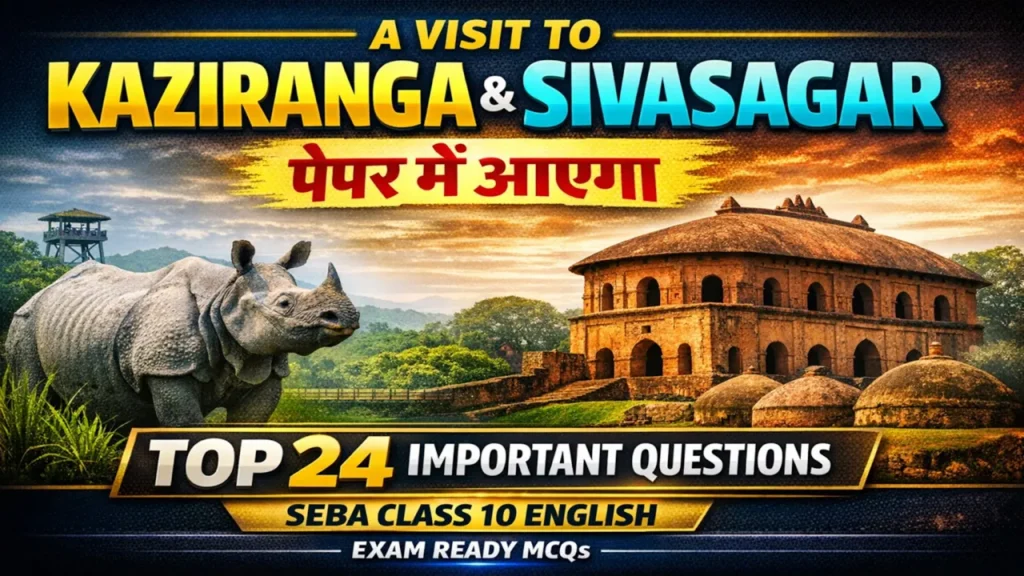
Why This “A Visit to Kaziranga and Sivasagar” Test Matters?
Exam Weightage: This topic carries significant marks in the HSLC English paper.
Difficulty: Moderate to Hard.
Recommended: Check this SEBA Class 9 English Syllabus for more details.
Practice A Visit to Kaziranga and Sivasagar (Live Mock Test)
⚠️ Content Protected
Join our Telegram for PDF: t.me/ExamReadyMCQs
A Visit to Kaziranga and Sivasagar – Top 24 Solved MCQs (24 MCQs Test)
⚠️ Select an answer!
According to the history of Kaziranga, which specific event in 1904 prompted the initiation of conservation efforts for the rhinoceros?
Explanation:
Correct: B
Lady Curzon visited the area in 1904. Despite the fame of the rhinos, she could not see a single one, only hoof marks. Concerned by this, she persuaded her husband, Lord Curzon, to take urgent measures to protect them. This event is a key highlight in the chapter A visit to Kaziranga and Sivasagar and marked the start of conservation.
▶ Watch Video Explanation
In which year was Kaziranga officially declared a National Park?
Explanation:
Correct: C
Kaziranga was designated a Reserve Forest in 1905, a Game Sanctuary in 1916, and eventually declared a National Park in 1974. Understanding these dates is crucial when studying A visit to Kaziranga and Sivasagar for the SEBA Class 10 English exam, as timeline questions are very common.
▶ Watch Video Explanation
Kaziranga National Park is situated on the south bank of the Brahmaputra river. It covers areas primarily falling under which two districts?
Explanation:
Correct: A
The park is situated in the Golaghat and Nagaon districts of Assam. While reading A visit to Kaziranga and Sivasagar, students must note the geographical location of the park on the south bank of the Brahmaputra, as this is a fundamental fact about Assam Heritage Sites.
▶ Watch Video Explanation
Which of the following pairs regarding the timeline of Kaziranga’s status is INCORRECTLY matched according to the text?
Explanation:
Correct: D
This is the incorrect pair. 1974 was the year it became a National Park. It was inscribed as a UNESCO World Heritage Site later, in 1985. Memorizing this timeline is essential for mastering the chapter A visit to Kaziranga and Sivasagar and scoring well in your exams.
▶ Watch Video Explanation
Consider the following statements about the Indian Rhinoceros: 1. It is known as the one-horned rhinoceros. 2. The horn is made of solid bone attached to the skull. 3. The horn is composed of compressed hair (keratin). Which statements are factually correct based on the lesson?
Explanation:
Correct: B
The “horn” is not actually bone (Statement 2 is false). It is composed of compressed hair, similar to human fingernails (keratin). Statement 1 is correct. This biological fact is often highlighted in A visit to Kaziranga and Sivasagar to dispel common myths about the Indian Rhinoceros.
▶ Watch Video Explanation
The text mentions that Kaziranga supports a wide variety of “Flora” and “Fauna”. What does the term “Flora” specifically refer to?
Explanation:
Correct: B
In biological and geographical terms, “Flora” refers to plants and vegetation, while “Fauna” refers to the animals. This vocabulary distinction is important in the SEBA Class 10 English syllabus, specifically within the context of A visit to Kaziranga and Sivasagar.
▶ Watch Video Explanation
Consider the following statements regarding the early history of the park: Assertion (A): Lady Curzon requested Lord Curzon to stop the hunting of rhinos immediately. Reason (R): She witnessed a large herd of rhinos being hunted during her visit in 1904.
Explanation:
Correct: C
Assertion A is true; she did request protection. However, Reason R is false because she did not see any rhinos (only hoof marks), which was the very reason she was concerned about their dwindling numbers. This narrative is central to the introduction of A visit to Kaziranga and Sivasagar.
▶ Watch Video Explanation
Scenario: Lohit and Trisha are traveling with their parents to Kaziranga. They are driving along National Highway 37. Trisha notices dense greenery on both sides of the road and asks her father about the vegetation. Based on the text, what specific type of large trees is she likely seeing in the park area besides the tall grass?
Explanation:
Correct: B
The vegetation of Kaziranga consists of tall “Elephant grass” and scattered “Silk Cotton” (Simolu) trees. Descriptions of the landscape are a key literary element in A visit to Kaziranga and Sivasagar, helping students visualize the unique ecosystem of Kaziranga National Park History.
▶ Watch Video Explanation
Before it was known as Sivasagar, this historic town was the capital of the Ahom Kingdom. What was it known as during the Ahom rule?
Explanation:
Correct: B
Sivasagar was formerly known as Rangpur, the old capital of the Ahoms. Knowing the ancient names of cities is a frequent question pattern in the English Exam of Secondary Education Board of Assam (SEBA) when covering the chapter A visit to Kaziranga and Sivasagar.
▶ Watch Video Explanation
Scenario: Trisha observes a two-storied red brick building. Her father explains that it was used by the Ahom royals to watch buffalo fights and other sports. He points out its roof, which has a very peculiar shape. What is the shape of the roof of the Rang Ghar described as?
Explanation:
Correct: A
The Rang Ghar is described as having a roof shaped like an inverted boat. It is often referred to as the “Amphitheatre of the East.” This architectural detail is a defining feature mentioned in A visit to Kaziranga and Sivasagar and represents unique Ahom Kingdom Monuments.
▶ Watch Video Explanation
Which of the following pairs linking an Ahom King to a monument is INCORRECT based on the history provided in the lesson?
Explanation:
Correct: D
This is the incorrect pair. The Shiva Dol (and the tank) was built by Queen Ambika, the wife of Swargadeo Siva Singha. Correct attribution of builders is critical for accuracy in A visit to Kaziranga and Sivasagar questions for HSLC Common Questions.
▶ Watch Video Explanation
Consider the following statements regarding the construction materials used by the Ahoms: Assertion (A): The Ahom monuments like Rang Ghar and Talatal Ghar have survived for centuries despite severe earthquakes. Reason (R): The builders used a special mortar made of sticky rice and duck eggs to bind the bricks.
Explanation:
Correct: A
The durability of these structures is attributed to the indigenous cement (mortar) which was a mixture of sticky rice (Bora Chaul) and duck eggs. This unique fact about Ahom engineering is a favorite topic in A visit to Kaziranga and Sivasagar discussions.
▶ Watch Video Explanation
Which of the following statements accurately describe the architecture of the Talatal Ghar? 1. It has a total of seven stories. 2. Three of its stories are underground. 3. It has two secret underground tunnels.
Explanation:
Correct: D
All statements are correct. The Talatal Ghar is a seven-story structure (4 above ground, 3 below). It served as a military base and had two secret escape tunnels. These details make the Talatal Ghar a fascinating part of A visit to Kaziranga and Sivasagar.
▶ Watch Video Explanation
On the banks of the Sivasagar tank, there are three main temples (Dols). Which of the following is NOT one of them?
Explanation:
Correct: D
The three temples standing on the bank of the Sivasagar tank are the Shiva Dol, the Vishnu Dol, and the Devi Dol. The Surya Dol is not present. Students must list the correct temples when summarizing their learning from A visit to Kaziranga and Sivasagar.
▶ Watch Video Explanation
The Joysagar Tank is considered one of the largest man-made lakes in India. In whose memory was this tank excavated by Swargadeo Rudra Singha?
Explanation:
Correct: B
Swargadeo Rudra Singha dug the Joysagar tank in memory of his mother, Sati Joymoti, who sacrificed her life for her husband. This emotional historical context adds depth to the narrative in A visit to Kaziranga and Sivasagar.
▶ Watch Video Explanation
While traveling on the National Highway towards Sivasagar, the travelers crossed a historic bridge built by the Ahom King Rudra Singha. What is the unique feature of the “Namdang Stone Bridge”?
Explanation:
Correct: B
The Namdang Stone Bridge is unique because it was constructed by carving it out of a single solid piece of rock. This marvel of engineering is briefly but significantly mentioned in A visit to Kaziranga and Sivasagar.
▶ Watch Video Explanation
In the context of Ahom history, the term “Maidam” refers to which of the following structures?
Explanation:
Correct: C
A “Maidam” is a tumulus or burial mound, specifically the burial grounds of the Ahom kings and nobles, traditionally found at Charaideo. This term is a crucial vocabulary word in A visit to Kaziranga and Sivasagar.
▶ Watch Video Explanation
Which of the following statements correctly describe the Charaideo Maidams? 1. They are often compared to the Pyramids of Egypt. 2. The site was the permanent capital of the Ahom kingdom for 600 years. 3. The hillock at Charaideo is considered sacred.
Explanation:
Correct: B
Statement 1 and 3 are correct. Statement 2 is incorrect because the capital shifted. Understanding the significance of Charaideo is vital for the English Exam of Secondary Education Board of Assam (SEBA) when studying A visit to Kaziranga and Sivasagar.
▶ Watch Video Explanation
Which Ahom ruler is credited with establishing the first capital of the Ahom Kingdom at Charaideo in 1228 AD?
Explanation:
Correct: C
Chaolung Siu-Ka-Pha was the founder of the Ahom kingdom and established his first capital at Charaideo in the 13th century. This foundational fact is the starting point for Ahom history in A visit to Kaziranga and Sivasagar.
▶ Watch Video Explanation
Consider the following statements regarding Ahom geography: Assertion (A): The Charaideo hillock was maintained as a sacred site even after the capital was moved. Reason (R): The Ahoms believed that Charaideo was the dwelling place of their ancestral gods.
Explanation:
Correct: A
The sanctity of Charaideo (Assertion) stems directly from the spiritual belief that it was the home of the ancestral gods (Reason). This cultural insight is explored in A visit to Kaziranga and Sivasagar.
▶ Watch Video Explanation
While Sivasagar is famous for Ahom monuments, not all major heritage sites are located there. Which of the following historic towns is NOT located within the Sivasagar district?
Explanation:
Correct: D
Charaideo, Gargaon, and Rangpur are historic Ahom capitals located in or near the Sivasagar district. Tezpur is a separate historic city in Sonitpur. Geographic clarity is needed when revising A visit to Kaziranga and Sivasagar.
▶ Watch Video Explanation
Scenario: A tourist visiting Assam wants to see the “Amphitheatre of the East” and the “Pyramids of Assam.” Which two locations must this tourist visit?
Explanation:
Correct: A
The “Amphitheatre of the East” refers to the Rang Ghar, and the “Pyramids of Assam” refers to the Charaideo Maidams. These metaphors are frequently used in the text of A visit to Kaziranga and Sivasagar.
▶ Watch Video Explanation
Which of the following pairings of an Ahom Monument and its Builder is historically INCORRECT?
Explanation:
Correct: D
The Namdang Stone Bridge was built by Swargadeo Rudra Singha, not the kingdom’s founder Siu-Ka-Pha. Historical accuracy regarding builders is a strict requirement for A visit to Kaziranga and Sivasagar quizzes.
▶ Watch Video Explanation
Geographically, the sacred burial site of Charaideo is located approximately how far from the main town of Sivasagar?
Explanation:
Correct: B
Charaideo is situated approximately 22 kilometers away from the Sivasagar town center. This specific distance is mentioned in the travelogue section of A visit to Kaziranga and Sivasagar.
▶ Watch Video Explanation
Completed!
Score: 0/24
Quick Revision: Key Facts for A Visit to Kaziranga and Sivasagar
Conservation Origin: Lady Curzon’s 1904 visit was the catalyst for protecting the rhinos in A visit to Kaziranga and Sivasagar.
Rhino Horn: It is not bone but compressed hair (Keratin), a unique biological fact.
Rang Ghar: Known as the “Amphitheatre of the East,” it has an inverted boat-shaped roof.
Ahom Cement: A mixture of sticky rice and duck eggs ensured the longevity of monuments.
External Reference: For official data on these sites, visit [EXTERNAL_LINK]Assam Tourism Official Website[/EXTERNAL_LINK].
Frequently Asked Questions
Why is A visit to Kaziranga and Sivasagar important for the SEBA Exam?
It appears frequently in the exam. Mastering A visit to Kaziranga and Sivasagar ensures you secure easy marks in the objective section of the English paper.
Is this A visit to Kaziranga and Sivasagar MCQs test sufficient?
Yes, these questions cover the core syllabus. However, regular revision of the text is key to success.
What are the main monuments covered in this chapter?
The chapter focuses on Rang Ghar, Talatal Ghar, Shiva Dol, and the Charaideo Maidams.