⚠️ Content Protected
Join our Telegram for PDF: t.me/ExamReadyMCQs
Era of One-Party Dominance MCQ – 30 Most Expected Questions (30 MCQs)
In the context of Era of One-Party Dominance MCQ, this question examines the institutional setup of Indian elections. Sukumar Sen was the first CEC who supervised the colossal task of the first general election. This topic is vital for understanding the Congress System in India.
From the Era of One-Party Dominance MCQ syllabus perspective, this concept highlights the challenges of democracy in a newly independent nation. With only 15 percent literacy among 17 crore voters, the election was a bold experiment in universal adult franchise.
This concept within Era of One-Party Dominance MCQ is important because it traces the technological evolution of Indian elections. From separate ballot boxes to paper ballots and finally EVMs in 2004, the process has become more secure and efficient.
Exam questions from Era of One-Party Dominance MCQ often focus on the First Past the Post system. While Congress won 74 percent of seats, it only secured 45 percent of votes. The Reason is false, illustrating how seat share can disproportionately exceed vote share.
A key idea tested in Era of One-Party Dominance MCQ relates to the social challenges of the 1950s. The Election Commission refused to accept patriarchal entries like wife of, insisting on individual identity for women voters during the First General Election 1952.
Understanding this aspect of Era of One-Party Dominance MCQ helps aspirants distinguish between ruling and opposition strength. The CPI won 16 seats, making it the second-largest party, far behind Congress. This highlights the fragmented nature of Opposition Parties in India.
In the context of Era of One-Party Dominance MCQ, this question examines the tradition of simultaneous elections. Until 1967, Lok Sabha and State Assembly elections were held together, a significant feature of the early Congress System in India.
From the Era of One-Party Dominance MCQ syllabus perspective, this concept highlights global doubts about Indian democracy. Critics believed the vast illiteracy would cause the failure of the First General Election 1952, labeling it a gamble.
This concept within Era of One-Party Dominance MCQ is important because Rajni Kothari defined the era. He analyzed how Congress functioned as a grand coalition, absorbing opposition elements, which is central to understanding the Congress System in India.
Exam questions from Era of One-Party Dominance MCQ often focus on the inclusive nature of the party. The term Rainbow Coalition refers to its ability to accommodate diverse social groups and ideologies, preventing the rise of strong Opposition Parties in India.
A key idea tested in Era of One-Party Dominance MCQ relates to party structure. Congress remained a loose coalition rather than a rigid cadre-based party. This flexibility allowed it to dominate the political landscape during the First General Election 1952 era.
Understanding this aspect of Era of One-Party Dominance MCQ helps aspirants grasp the tolerance mechanism. Congress rarely expelled dissenters; instead, it managed differences internally, which is why it was called the Congress System in India.
In the context of Era of One-Party Dominance MCQ, this question examines the role of factions. Factions allowed internal competition, meaning the party acted as both government and opposition, strengthening the Congress System in India.
From the Era of One-Party Dominance MCQ syllabus perspective, this concept highlights the limits of inclusion. While Congress was a broad coalition of ideologies, it fundamentally stood for national unity and did not accommodate separatist elements.
This concept within Era of One-Party Dominance MCQ is important because it differentiates India from authoritarian states. Opposition Parties in India were active and legal; Congress won simply because it had more popular support during the First General Election 1952.
Exam questions from Era of One-Party Dominance MCQ often focus on internal party dynamics. A Faction is a group with common interests inside a larger party. This mechanism was crucial for the longevity of the Congress System in India.
A key idea tested in Era of One-Party Dominance MCQ relates to the first breach in Congress dominance. The CPI victory in Kerala in 1957 showed that democratic alternatives were possible, marking a milestone for Opposition Parties in India.
Understanding this aspect of Era of One-Party Dominance MCQ helps aspirants identify ideological roots. The Bharatiya Jana Sangh (BJS), forerunner to the BJP, prioritized cultural nationalism, distinct from the secular approach of the Congress System in India.
In the context of Era of One-Party Dominance MCQ, this question examines economic ideologies. The Swatantra Party favored market capitalism and opposed the socialist state control advocated by Congress, offering a clear alternative for voters.
From the Era of One-Party Dominance MCQ syllabus perspective, this concept highlights the end of the umbrella coalition. By banning dual membership, Congress forced the Socialists out, formally creating distinct Opposition Parties in India.
This concept within Era of One-Party Dominance MCQ is important because it contrasts democratic dominance with authoritarianism. Unlike the PRI in Mexico, the Congress System in India operated within a valid democratic framework.
Exam questions from Era of One-Party Dominance MCQ often focus on leadership. Shyama Prasad Mukherjee founded the Bharatiya Jana Sangh, not the Socialist Party. This knowledge is essential for mapping Opposition Parties in India.
A key idea tested in Era of One-Party Dominance MCQ relates to federal tensions. The use of Article 356 to dismiss the Communist government in Kerala was the first major instance of central misuse against Opposition Parties in India.
Understanding this aspect of Era of One-Party Dominance MCQ helps aspirants grasp global influences. The Sino-Soviet split caused the CPI to fracture into CPI and CPI(M), altering the landscape of Leftist politics in the Congress System in India.
In the context of Era of One-Party Dominance MCQ, this question examines early inclusivity. Nehru included opposition leaders to ensure national unity, showcasing the unique collaborative spirit of the early Congress System in India.
From the Era of One-Party Dominance MCQ syllabus perspective, this concept highlights political terminology. The Left supports state intervention for the poor, a stance held by parties like CPI, distinguishing them from the Rightist Opposition Parties in India.
This concept within Era of One-Party Dominance MCQ is important because it profiles key figures. Acharya Narendra Dev was a pivotal socialist thinker who influenced the ideology of many Opposition Parties in India after leaving Congress.
Exam questions from Era of One-Party Dominance MCQ often focus on comparative politics. The PRI in Mexico maintained dominance through corruption, contrasting with the democratic legitimacy of the Congress System in India.
A key idea tested in Era of One-Party Dominance MCQ relates to the timeline. The first election spanned from late 1951 to early 1952, a logistical marvel that established the credibility of the First General Election 1952.
Understanding this aspect of Era of One-Party Dominance MCQ helps aspirants correct misconceptions. Rafi Ahmed Kidwai was a staunch Congress leader and minister, not a member of the BJS or other Opposition Parties in India.
Completed!
Score: 0/30
The Biggest Gamble in History: The First General Election
To truly understand any Era of One-Party Dominance MCQ, you must first travel back to the year 1950. India had just become a republic. The leaders decided to give every adult the right to vote. This is called Universal Adult Franchise. Today, this seems normal. But back then, it was a massive shock to the world.
Why was it a shock? Because India was huge, very poor, and mostly uneducated. A British member of the Indian Civil Service (ICS) even called it “the biggest gamble in history.” A famous magazine predicted that Prime Minister Jawaharlal Nehru would live to see this experiment fail. They thought illiterate people could not choose a government.
The Hero of the First Election: Sukumar Sen
The government created the Election Commission of India in January 1950. They appointed Sukumar Sen as the very first Chief Election Commissioner. His job was like organizing the biggest wedding in human history, but with 17 crore (170 million) guests! He had to draw voting boundaries, train lakhs of officers, and make sure everything was fair. Without his brilliant planning, India’s democracy might have failed.
The Challenge of Naming the Voters
When the officers went from door to door to make the voter list, they faced a strange problem. In many parts of India, women did not tell strangers their real names. Instead, they registered themselves as “wife of Ram” or “daughter of Shyam.”
Sukumar Sen was very strict. He said this was unacceptable in a true democracy. Every woman must have her own identity. Because of this brave decision, the Election Commission had to delete nearly 40 lakh names from the first draft of the list. They told the officers to go back and get the real names. This detail is a favorite for examiners setting an Era of One-Party Dominance MCQ.
How Did Illiterate People Vote?
Another massive problem was literacy. Only 15 percent of the eligible voters could read and write. If they could not read the ballot paper, how could they vote? The Election Commission came up with a genius idea.
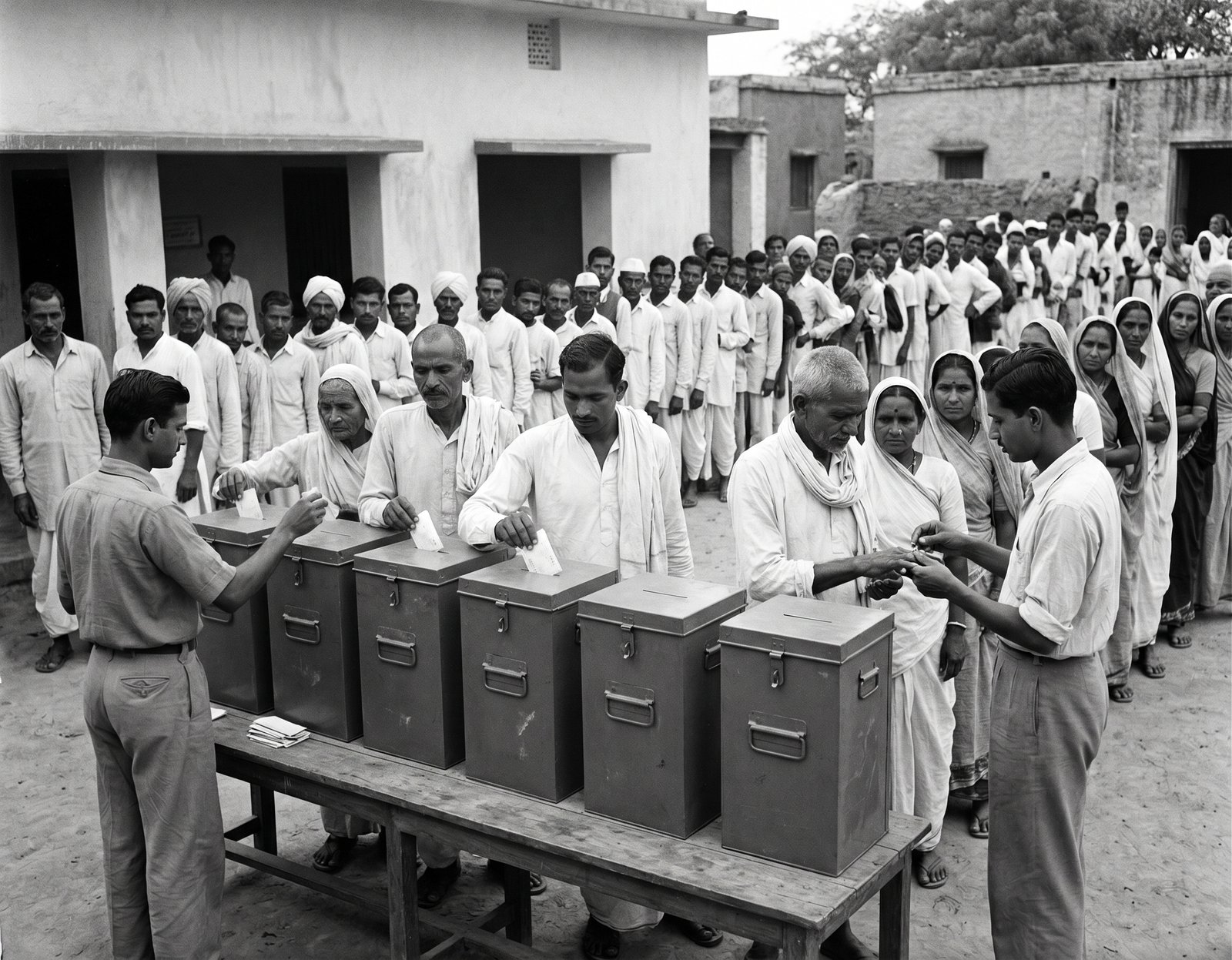
Instead of putting all candidate names on one paper, they placed separate ballot boxes for each candidate inside the voting booth. Each box had the candidate’s symbol painted on it (like a pair of bullocks or a hut). A voter just took a blank piece of paper and dropped it into the box of the symbol they liked.
EVOLUTION OF VOTING IN INDIA
├── 1952: Separate Ballot Boxes with Symbols
├── 1990s: Paper Ballots with Stamping
└── 2004: Electronic Voting Machines (EVMs) used nationwide
The Magic of Electoral Math: Votes vs. Seats
When the results of the First General Election (1951-1952) came out, the Indian National Congress won a massive victory. They captured 364 out of 489 seats in the Lok Sabha. The whole world was shocked by the scale of the victory. But there is a mathematical secret behind this huge win.
If you study the numbers closely, the Congress party did not win 75% of the votes. They only won about 45% of the total valid votes. So, how did 45% of votes turn into 74% of the seats?
First Past the Post System
India follows a voting rule called the “First Past the Post” system. Imagine a running race. The person who crosses the finish line first wins the gold medal. It does not matter if they win by one second or ten seconds.
In Indian elections, the candidate with the highest number of votes in a constituency wins the seat. The votes given to the losing candidates are basically wasted. Because the opposition votes were divided among many small parties, the Congress easily won the most seats, even without a majority of the total votes!
Here is a simple visual chart explaining this electoral math:
Understanding the Congress System in India
Why did the Congress party win election after election for the first fifteen years? A famous political scientist named Rajni Kothari created a special term for this. He called it the Congress System.
To understand this for your Era of One-Party Dominance MCQ test, you must know that the Congress of the 1950s was not a normal, rigid political party. It was a massive umbrella. It was like a giant sponge that absorbed everyone.
The Rainbow Coalition
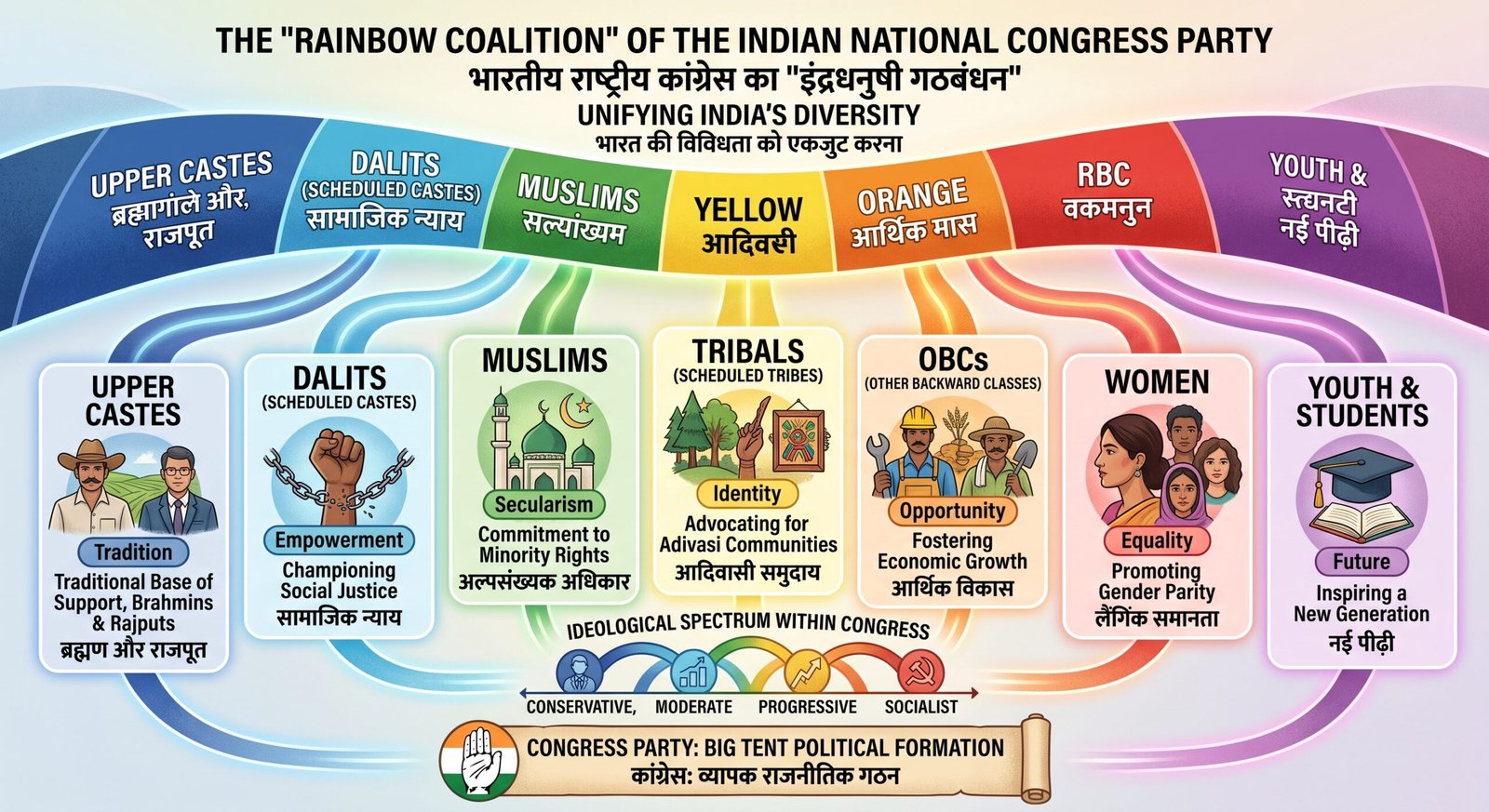
By the time India won independence, the Congress had changed from a small group of rich professionals into a massive people’s movement. It became a Rainbow Coalition. This means it included people of all colors, castes, religions, and classes.
Inside the Congress, you could find rich factory owners and poor factory workers. You could find powerful landlords and landless farmers. You could find extreme conservatives and wild radicals. They all stayed under one roof because the party promised to fight for the whole nation.
The Power of Factions
Normally, if a party has too many inner groups fighting with each other, the party breaks apart. But in the Congress system, these inner groups (called factions) were actually a superpower.
If a farmer leader inside Congress felt ignored, he did not leave to start a new party. Instead, he formed a faction inside Congress to argue his case. Because Congress tolerated all these different voices, it acted as both the ruling party and the opposition party at the same time!
Democratic Dominance vs. Dictatorship
When a single party rules a country for a long time, we usually assume it is a dictatorship. For example, look at China, Cuba, or Syria. Their constitutions only allowed one party to exist by law.
But India was different. The dominance of the Congress happened under completely democratic conditions. Other political parties were completely legal. They had their own newspapers, held public rallies, and fought in elections. To get more context on world history, check out this fascinating overview of the First General Election.
Let us look at a famous comparison that always appears in exams:
| Feature | India (Congress Party) | Mexico (PRI Party) |
|---|---|---|
| Type of Rule | Democratic Dominance | Authoritarian Dominance |
| Elections | Free, fair, and open to all | Rigged, manipulated, and violent |
| Opposition | Legal and respected | Crushed and silenced |
The Rise of Strong Opposition Parties in India
Even though Congress was huge, it was not the only party in town. In the very first election, the root of all modern opposition parties was planted. The second largest party in the 1952 Lok Sabha was the Communist Party of India (CPI), winning 16 seats.
Let us look closely at these opposition players, as they are a heavy focus in any Era of One-Party Dominance MCQ. For a deeper dive into modern equivalents, read our guide on Supreme Court & High Court.
The Communist Party of India (CPI)
The Communists believed in the rights of the poor workers and farmers. They were very popular in states like Kerala, West Bengal, and Andhra Pradesh. In fact, they made world history in 1957!
In the 1957 state elections, the CPI defeated the Congress party in Kerala. They formed the first democratically elected communist government in the whole world! The Chief Minister was E.M.S. Namboodiripad. However, the Congress leaders in New Delhi were very upset.
The Misuse of Article 356
In 1959, the central government used Article 356 (President’s Rule) of the Constitution to dismiss the Communist government in Kerala. They claimed there was a breakdown of law and order. This was highly controversial. It was the very first time the central government used emergency powers to crush an elected opposition government.
Later, in 1964, the CPI faced a massive split. The world was divided between the Soviet Union (Russia) and China. The Indian communists also fought over this. The pro-Soviet group stayed as the CPI, while the pro-China group broke away to form the CPI(M) or Communist Party of India (Marxist).
The Socialist Party
The Socialists originally started inside the Congress party back in 1934. Their founding president was Acharya Narendra Dev. The Socialists wanted to help the poor but also believed deeply in democracy (unlike some extreme communists).
In 1948, the Congress party changed its rules. They banned people from holding dual memberships. This forced the Socialists to leave Congress and form their own separate political party. Famous leaders like Jayaprakash Narayan and Ram Manohar Lohia belonged to this group.
The Bharatiya Jana Sangh (BJS)
Founded in 1951 by Shyama Prasad Mukherjee, the Bharatiya Jana Sangh was very different from the Leftist parties. While the communists talked about money and workers, the BJS talked about culture and tradition.
Their main slogan was “One Country, One Culture, and One Nation.” They believed that India could only become strong by building on its ancient Hindu culture. They also strongly demanded the reunification of India and Pakistan into an “Akhand Bharat” (Undivided India). Today’s powerful Bharatiya Janata Party (BJP) traces its roots directly back to the BJS.
The Swatantra Party
Formed in 1959, the Swatantra Party was led by veteran freedom fighters like C. Rajagopalachari and Minoo Masani. They had a very simple, core belief: the government should stop interfering in business.
During the 1950s, the Congress government liked to control factories and farms. You needed government permission (a license) to start almost any business. The Swatantra Party hated this “license-permit raj.” They believed in a free-market economy where private companies could grow without strict government control.
Simultaneous Elections and the First Cabinet
In the early years, voting was a beautiful, combined festival. When a villager went to the polling booth in 1952, 1957, or 1962, they did not just vote for the Prime Minister. They voted for both the Lok Sabha (National Parliament) and the State Assembly (Local Government) at the exact same time! This system saved money and time, but it ended in 1967.
Finally, it is vital to know that the first government of free India was very generous. Prime Minister Nehru wanted a team of all talents. He invited strict opposition leaders to join his very first Cabinet. Dr. B.R. Ambedkar, who was a fierce critic of Congress, became the Law Minister. Shyama Prasad Mukherjee, who later formed the BJS, was also a minister! This shows how cooperative the early era was.